

Tonight the Fullerton City Council will consider approving what could be the worst mixed use housing project in the city’s history. Fullerton Harborwalk would be built on 2.9 acres of what had been a car lot on Habor Blvd. between Orangethorpe Ave. and Ash Ave. The land is currently zoned for “Commerical” use, and would require a re-zoning to “Neighborhood Center Mixed Use,” as well as a General Plan amendment, according to the staff report.
This new pile of junk is just another massive block of four storey mediocre street frontage that will no doubt be justified as somehow activating the block by not having a proper setback and being transportation friendly because it’s on a bus route. Harborwalk features no traffic mitigation, or even adequate ways to access the exisiting streets. And it’s shoved right up against the neighborhood behind it.
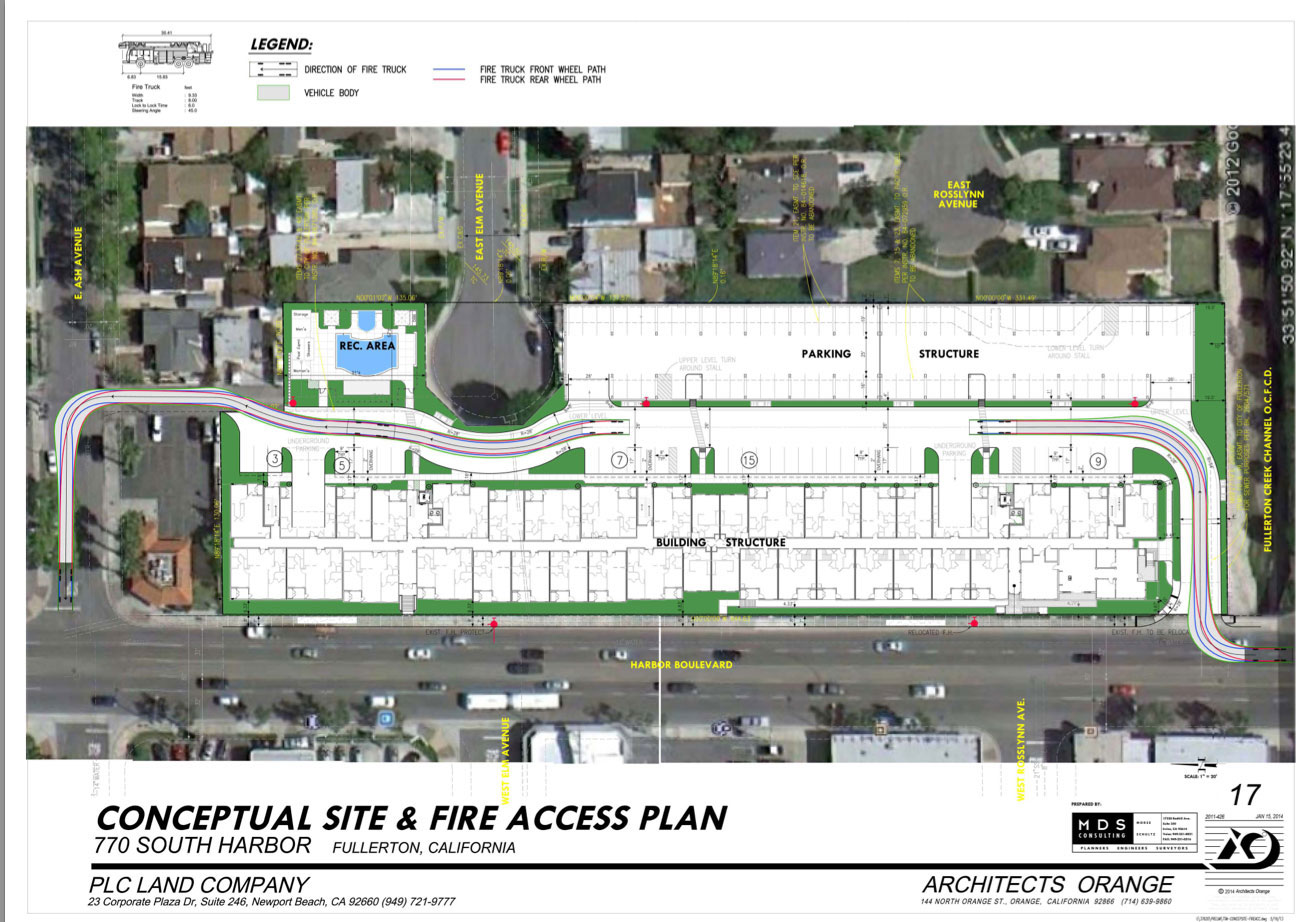
How would you like to live behind this thing?
How bad is it? So bad that several Fullerton Planning Commissioners had unresolved problems with the plan, leading them to vote against supporting it in February, although enough of them went along with this awful plan to send it on its way to council. The project seems to have brought the Friends for Fullerton’s Future briefly out of retirement long enough to post some excerpts from the meeting to Youtube. (The full video can be found on the city’s website, but, oddly, no notes from any Planning Commission meetings from 2014 are posted.)
A review of the staff report shows that of 150 units, only 7 are live/work. But then the staff report goes on to characterize this laughable disparity as “consistent” with the “Neighborhood Mixed Use” designation of Fullerton’s General Plan, which is “intended for nieghborhood centers that provide residents with opportunities to walk to retail and services businesses, residential uses, as well as gathering places such as plazas.” Do you see a plaza, or anyplace else to gather?
Then, as expected, the report refers to the Downtown Core and Corridors Specific Plan (DCCSP) “study area,” noting that the DCCSP “Development activity resulitng in attractive architecture and enhanced streetscape is desired as a means to increase the use of public transit, strengthen surrounding neighborhoods and improve the quality of life for the community.” Setting aside for the moment that Harborwalk fulfills none of these requirments other than having a bus line run near it, The Downtown Core and Corridors Specific Plan (DCCSP) has never been approved by anyone. It is still in the study phase, and yet Fullerton’s planning staff continually use it to justify proposed developments.
Fullerton Planning Commissioner John Silber called it’s characterization as a mixed use residential/retail development “a fig leaf,” going on to explain that it was really a “long, anonmyous apartment complex with a few live/work units mixed in which don’t represent anything in terms of vitality or breaking up that section of Harbor.” Earlier in the meeting Mr. Silber cited Jane Jacobs’ classic 1970 work the The Death and Life of Great American Cities, referring to the author’s observation that short city blocks allow for greater pedesitran circulation and interaction, while long blocks ceate isolated spaces.
“It doesn’t meet the standards on urban design,” Mr. Silber wisely commented.

A single central corridor six hundred feet long!
Harborwalk will require the consolitdation of different adjoining properties to create a single long block over six hundred feet long. For some perspective, that’s the length of two football fields (with a single nearly six hundred foot corridor running through it!). Is a single block that long consistent with the creation of “nieghborhood centers that provide residents with opportunities to walk to retail and services businesses, residential uses, as well as gathering places such as plazas?”
Jane Jacobs learned her lesson over four decades ago from the disastrous mid-century demolitions of whole neighbhorhoods which were replaced by massive mega-apartment blocks in eastern cities. Others read her book and belatedly shifted to a strategy of more permeable and walkable mixed use spaces, but not the developers of Harborwalk.
Fullerton’s General Plan is supposed to reflect the new thinking about active, walkable planning too, but this project was nonetheless approved and sent on to the council. Will the Fullerton City Council hold true to the stated goals of the General Plan, to create more a more livable city, or is that document and the Core and Corridors study just a whitewash for more massive, crummy apartment blocks wherever they can squeeze them in?
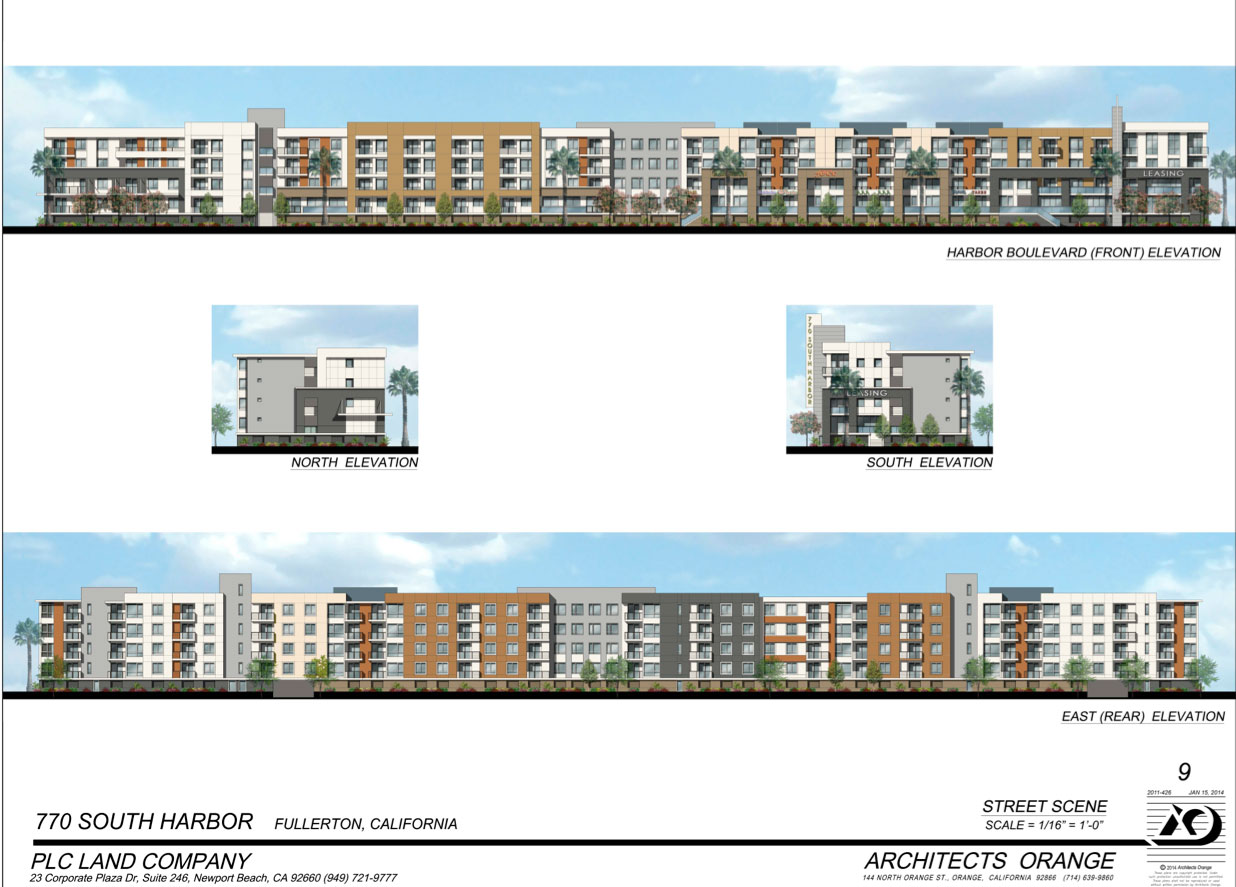
Massively dull, and utterly obstructive.



 fullertonrag.com