Archives for category: Greg Sebourn

UPDATE: The Rag has updated the video links on this post to separate them individually because some readers experienced problems playing all five videos as a playlist.

On Wednesday, November 25, the Fullerton City Council met at 8:00 a.m. for a Special Meeting to announce a settlement in the civil lawsuit brought by Ron Thomas, father of schizophrenic Kelly Thomas, beaten into brain death by members of the Fullerton Police Department four and half years ago. The council had already met in a closed session meeting two days earlier on Monday, November 23 to decide whether or not to settle the case, scheduled to begin that very morning in a Santa Ana courtroom. Council members Jan Flory, Doug Chaffee, and Mayor Pro Tem Jennifer Fitzgerald voted in favor of the settlement, while Mayor Greg Sebourn and Council member Bruce Whitaker voted against it.

Although video of the November 23 meeting is available on the city’s website, along with other archived videos of past meetings, no such video can be found there of the Nov. 25 meeting. CORRECTION: The November 23 meeting was not recorded either, even though several members of the public offered comments prior to the council retreating into Closed Session. When pressed for an answer about the video’s absence by Parks and Recreation Commissioner Barry Levinson during public comments at the regularly scheduled December 1 City Council meeting, City Clerk Lucinda Williams responded that the city’s contract only covered regular meetings, and that a special call needed to have been made to arrange for the video recording of special meetings, and that that call had not been made ahead of the November 25 meeting.

The timing of the November 25 meeting was already suspect. Rather than wait until the regularly scheduled December 1 evening meeting, which would be both video recorded and broadcast live, to announce the expensive and embarrassing settlement, a Special Meeting was quickly scheduled early in the morning on a weekday, the day before the Thanksgiving holiday break. There is no logical reason for not video recording the November 25 session, which was a pubic announcement. Although a complete recording of that meeting is not known to exist, the Fullerton Rag does have five videos shot from the audience to preserve parts of the proceedings. Below are the announcement of the settlement by City Attorney Richard Jones, along with explanations by four council members of their respective support or opposition to the decision (Council member Jan Flory was not present for the November 25 meeting). Click the links below to hear remarks by each present member of the Fullerton City Council.

First, City Attorney Richard Jones reads the settlement text..

Mayor Greg Sebourn…

Council member Bruce Whitaker..

Council member Doug Chaffee…

And the customarily perfunctory remarks by Mayor Pro Tem Jennifer Fitzgerald…


Your tax dollars at work.

Your tax dollars at work.

“Journalism is printing what someone else does not want printed: everything else is public relations.”

—George Orwell

It is no accident that our modern author most revered for his insights into authoritarianism also supplies the best ever quote about newspapers. George Orwell was himself a journalist prior to writing Nineteen Eighty-Four, his chilling and depressingly relevant masterpiece about a totalitarian state where the government exercises complete control over printed information. Prior to adopting his now famous pseudonym, the author, whose real name was Eric Blair, was also a police officer in what was then the British colony of Burma, a position that gave him direct experience with armed authority over a subjugated population.

The title of OC Register columnist David Whiting’s recent story about police public relations firm Behind the Badge should recall Mr. Orwell’s definition of journalism.  His June 20 column,  Revealing what’s ‘Behind the Badge’: Paid for by police and taxpayers, but how much does that matter? is undoubtably a reaction to a story from the Voice of OC website by Thy Vo, published on June 1, entitled Website Blurs Line Between Journalism and PR.

OC Register columnist David Whiting ponders whether or not paid public relations is any different than what his newspaper does for free.

OC Register columnist David Whiting ponders whether or not paid public relations is any different than what his newspaper does for free.

The Rag, of course, brought this issue to light way back on December 12, 2013, in a post entitled The OC Register and Fullerton Police, Partners in Propaganda. We pointed out that the Fullerton Police Department was paying a public relations company called Cornerstone Communications, who publishes a website called Behind the Badge OC, to write positive stories about the FPD, and that the OC Register was uncritically publishing those stories with inadequate acknowledgment to readers that they were generated by a paid PR firm led by former OC Register reporter Bill Rams.

Even the Register’s own David Medzerian later called for the Behind the Badge website to carry “a more prominent disclaimer so readers know who’s paying for it” in a March 29, 2015 column called What’s hidden ‘Behind the Badge’?

And why should we taxpayers be funding a public relations firm to write stories about our own police department, when that department’s union actively funds the campaigns of candidates for Fullerton City Council?

This brazenly political effort to improve the image of the FPD goes back to a 2012 report produced by Michael Gennaco’s Office of Independent Review (OIR) about the state of the Fullerton Police Department in the wake of the beating death of the schizophrenic homeless Kelly Thomas the previous year. In that report the OIR recommended that the Fullerton Police Department communicate better with the public following “incidents”. Was hiring a PR firm to do nothing but write rosy stories about police what they had in mind?

Some may agree that using a PR firm might be a good example of outsourcing specialized skills to private sector professionals, but one has to question the intent of the contract with Cornerstone Communications and the results of their work. Shouldn’t the purpose of the PR work be to better inform Fullerton residents about their police department’s actions? At the very least, we should feel like we know something more about how police operate in our community.

David Whiting’s recent column quotes Fullerton Police Chief Dan Hughes as justifying the expense: “The community wants to know their police department better,” and “These stories are an extremely effective way to communicate.”

Communicate what?  Readers of Behind the Badge won’t find valuable insights about how police work in their city. Instead, the site’s Fullerton page is loaded with stories about remembering a long dead officer, a  profile of a volunteer senior citizen, the Special Olympics, and (no kidding) the FPD being honored at a kickball match. These stories are grouped under the “features” heading, but dominate the page, with accompanying pictures, while the “news” section has only one story that might actually qualify as news. Nowhere to be found, for example, is a report on the annual audit of the FPD by Michael Gennaco’s Office of Independent Review, which would make a really good news story that would be of great interest to Fullerton residents.

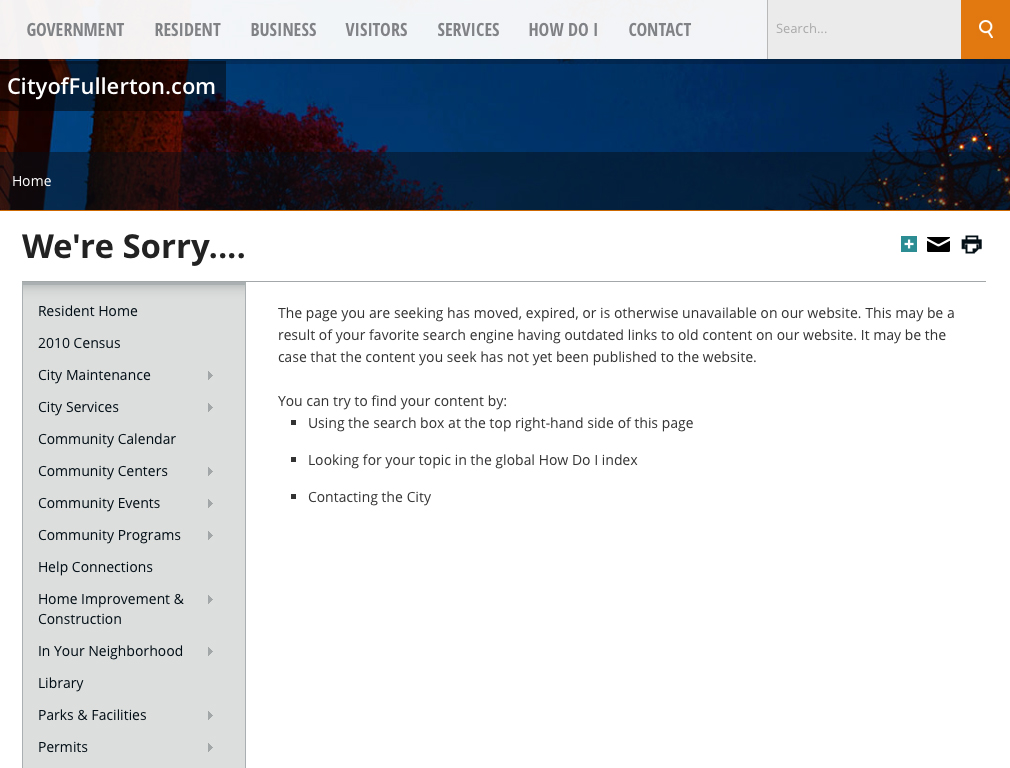
Behind the Badge’s Fullerton page also has a link that is supposed to lead directly to the FPD’s own website, but at press time it led here:

We're sorry we don't use the money you pay us to fix broken links...

We’re sorry we don’t use the money you pay us to fix broken links…

The link (perhaps repaired by the time you read this post) is supposed to lead  to the FPD’s own website, replete with more Behind the Badge generated pabulum for your consumption.

David Whiting’s recent column asks, pointlessly, whether or not what Cornerstone Communications produces is journalism. Columbia University Professor Susan McGregor  has an answer for him: ‘“It sounds like the structure is designed to skew in a direction,” McGregor allows. “Then it’s just another way of doing public relations.”

Thy Vo’s Voice of OC story quotes USC journalism Professor Marc Cooper as saying “what you’ve got here is a cereal commercial, a piece of uncritical advertising that is going to convince absolutely nobody who isn’t already convinced.” Which is exactly why Bill Rams and his cohorts find it necessary to place their PR stories in actual newspapers (ok, we’ll call it that) like the OC Register, where Mr. Rams is identified only as a “guest columnist” who owns a “communications company” with specified police department clients. Any reputable newspaper would simply run the story under the heading “Paid Advertisement” unless they weren’t being paid, in which case they shouldn’t run it at all, and leave writing about the police to their staff writers—those who haven’t already fled to write for PR firms like Cornerstone.

It’s also why the taxpayers of Fullerton are being ripped off. Even if anyone thought the FPD spending between “$ 2,000 and $ 5,000” a month to have positively-skewed stories about their own police department regurgitated back to them was a good idea, they might reasonably question the effectiveness of the whole enterprise in the first place. The Voice of OC has Prof. Cooper doubting that Behind the Badge will have “any impact at all.” But perhaps Prof. Cooper misses the point of the whole endeavor.

The goal of the FPD outsourcing public communications was never to improve communication between the police and the public they serve. The goal was to keep the Fullerton City Council from creating an Independent Police Commission that might foster actual communication between the FPD and the public. In order to achieve that goal the FPD had to wipe the mud from its name following the death of Kelly Thomas at the hands of FPD officers and other ugly revelations about the department so that their union endorsement would register as a positive in the minds of enough voters to back their candidates in City Council elections. They managed it barely in 2012 with their endorsed candidate Jan Flory’s 29 vote finish ahead of police critic incumbent Travis Kiger, who had been elected just six months prior in a recall election that was all but disastrous for the FPD. Their strategy proved to be effective when the trio of Jan Flory, Doug Chaffee, and Jennifer Fitzgerald* (joined by Greg Sebourn) utterly rejected a citizen-produced plan for actual oversight in favor of hiring the Office of Independent Review for periodic and incomplete audits of the FPD.

(The Police Oversight Proposal Committee’s plan for an independent oversight commission can be found at this link:

https://fullertonrag.com/proposal-for-a-fullerton-police-commission/)

For the combined money spent on paying Cornerstone and Michael Gennaco’s OIR, the city could hire the investigators who only might be required by an Independent Police Commission. Instead, precious taxpayer dollars are paid to a PR firm to serve the interests of the police department itself, contributing nothing to public safety.

In his column, David Whiting acknowledges that “as with other public relations specialists, Rams has suggested column ideas to me and I have pursued some.” Journalists are always being courted by PR specialists to write stories benefiting their clients. What’s remarkable about Mr. Whiting is that he evidently listens to them, demonstrating the kind of relationship with a PR firm that we should find unacceptable with a politician, and unprofessional in a journalist.

“Regardless, the backers of Behind the Badge are right about the need for better connections between police and public,” concludes David Whiting, who doesn’t seem to consider the possibility that those connections might otherwise come from honest journalism in a newspaper or on a news website instead of a one-sided public relations website. Readers of the OC Register should expect the former, while Fullerton taxpayers should be outraged that they are paying for the latter. Hucksters of “hybrid journalism,” as Behind the Badge’s Bill Rams calls it, can make a living as best they can, but you and I shouldn’t have to support them. The City Council should act to end this contract with Cornerstone Communications as quickly as possible and simply require the Fullerton Police Department to be honest, timely, and transparent in communications with the city’s residents.

*Mayor Pro Tem Jennifer Fitzgerald, who is herself Vice President of the public relations firm Curt Pringle & Associates, routinely supports the police department without any funding from the Fullerton Police Officers Association, thereby keeping them from opposing her campaigns while simultaneously preserving her Republican anti-union funding credentials.


Note: This post was updated on June 11 to correct typographical errors and to add an image of David Whiting’s recent column.

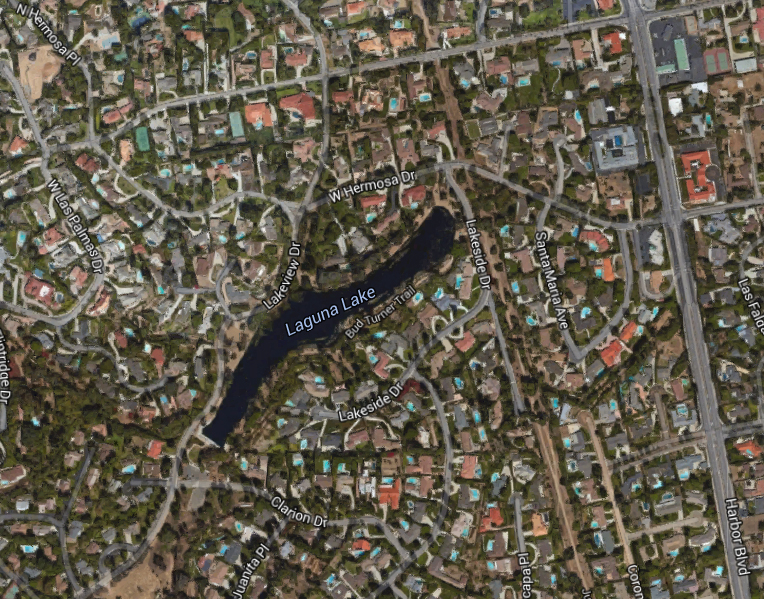
Laguna Lake

Laguna Lake

If you haven’t been to Laguna Lake, you’ve probably at least heard of it. The century old  artificial body of water is located just east of Euclid Avenue next to an equestrian center used by area horse enthusiasts. The neighborhood surrounding it is an affluent one of mostly single story estates with plenty of greenery, but people from all walks of life enjoy the lake. Whether fishing, speeding by on a mountain bike, feeding the birds, or just enjoying a stroll on the shore, Laguna Lake has become one of the treasured places of respite for generations of Fullerton residents.

Eleven years ago the lake was drained to clean up decades of debris, manmade and otherwise. City workers tell tales of bicycles and shopping carts revealed as the water level dropped, but the real surprise was the discovery of a live one hundred pound snapping turtle, nicknamed Bob, and estimated to be up to fifty years old. Rumors of a monster in the lake turned out to have some basis in reality…

Over a decade later there was another surprise announcement: Since the 2004 renovation, Laguna Lake has been losing 90,000 gallons of water a day, and has to be constantly refilled through a two inch pipe to keep it from drying up. And, because of its location, the lake is fed by Metropolitan Water District water, the most expensive the city purchases. Naturally, some water evaporates, and the lake would have to be topped off regularly anyway, but a much greater amount of water is being lost to something other than normal evaporation, and nobody seems to know where it is going.

The revelation of the huge daily water loss came during a water savings plan agenda item before the Fullerton City Council on May 19, when the Parks and Recreation Department recommended turning off the tap to help comply with drought restrictions throughout the city. What was especially surprising to hear was that the city staff evidently had known about this massive leak for at least five years. One council member commented later that they had never been told about it.

City Engineer Don Hoppe explained during the May 19 meeting that no source had yet been found for the leak, despite divers having been sent down into the lake with dyes to discover where all of the water was going. He speculated that several feet of duck “butter” might have acted as a seal during decades prior to the scouring of the lake bed in 2004.

Just a week later, during a question and answer session following his “Mini” State of the City presentation at the Fullerton Public Library, Mayor Greg Sebourn cited 100,000 to 150,000 gallons of water escaping the lake each day. The significant discrepancy between the lower estimate and the six figure ones can presumably be explained by the higher evaporation rate during summer months.

The plan presented on May 19 recommended simply shutting off the tap. Naturally, area residents were not thrilled with the idea of letting the lake go dry. Dozens of them attended the meeting to voice fears of crime and stagnant water breeding mosquitos that might carry West Nile virus, a serious concern, to be sure. Several area residents in attendance asked why the lake had not been lined when the costly and time consuming restoration had been performed years before. Engineer Hoppe explained that the strategy was to keep the lake in more of a natural state.

A mystery akin to finding the source of the Nile in the 19th century now occupies the city hall as they try to find out what is happening to all of that water, but it isn’t the only mystery at hand. The other is, why wasn’t anyone outside of the city government aware of this daily disaster until now, until all California cities were required to present plans for reducing water usage? An article in the OC Register noted that Laguna Lake is now the city’s largest water user. What the Register didn’t note was that “the city” doesn’t pay for any of it, you do. The cost of the water is spread out among all of the paying customers. And, remember that you, the ratepayer, are already paying extra money on your bill each month to lease the water department’s land, even though the water department is part of the city too. For that double charge you’d think we’d at least deserve to know about such a huge and longstanding problem.

Ultimately, on May 19, nothing was resolved, and the matter was scheduled for reconsideration at the next meeting, scheduled for June 2.

On June 2 the staff’s new recommendation was short and to the point: Give us some more money to find out how to fix the problem. How much? A maximum of $ 2,000,000.00.* That’s two million dollars, for those who don’t like to count zeros. That’s as much money as the city’s contribution to the 2004 renovation. The money would come from “Sanitation Fund reserves.” Who knew there was that kind of money around? The plan would require a repayment plan, at least. The source of repayment would more than likely be parks fees. As City Engineer Don Hoppe explained, the first money would be spent to hire a professionals to formulate and present a few alternatives, which were expected to include the following:

  1. Disperse materials to trace the leak. Described as relatively inexpensive, but it may not stop the leaks.
  1. Drill into the water around the lake, rescue the water, if it’s available, and re-use it somewhere else. But it may not be found, and could create more problems, like accelerating the leakage. And the water may not be safe for other uses anyway.
  1. Drain it, scrape it, and re-line it. Try to save the appearance and habitat. Everything would have to be stripped, and, more than likely, the lake would not look like it does now.

Mr. Hoppe explained that when the 2004 renovation was performed and the lake refilled, it was thought that the immediate water losses, apparent even then, would diminish as cracks in the clay underlying the lake were filled in, creating a new seal at the bottom. But the water just kept leaking, and hasn’t stopped since. At least, Mr. Hoppe made it clear that they would not be using the same consulting firm from the 2004 renovation this time, although they had actually been approached by them recently.

The middle of California’s most severe drought in 1,200 years, by some estimates, is a terrible time to be caught with a persistent and significant water loss in a non-essential recreational lake. It is troubling to think that the problem might not have come to the public’s, or even the City Council’s, attention had the city not been faced with planning for unprecedented state mandated cuts in water use.

If we base Laguna Lake’s daily water loss on an average of 100,000 gallons per day, it has been losing 36,500,000 each year. This is a significant problem that few people were aware even existed a month ago, but just because it’s been happening for years doesn’t mean it’s acceptable to let it go on any longer. It’s imperative that this tremendous waste of water is ended as soon as possible. Area residents are understandably concerned about the possibility of losing the lake, but should keep in mind that it’s not a naturally occurring one, and, like any landscape luxury, can be very costly to maintain over time.


*An earlier version of this post showed the wrong number of zeros, owing to a misplaced period.