
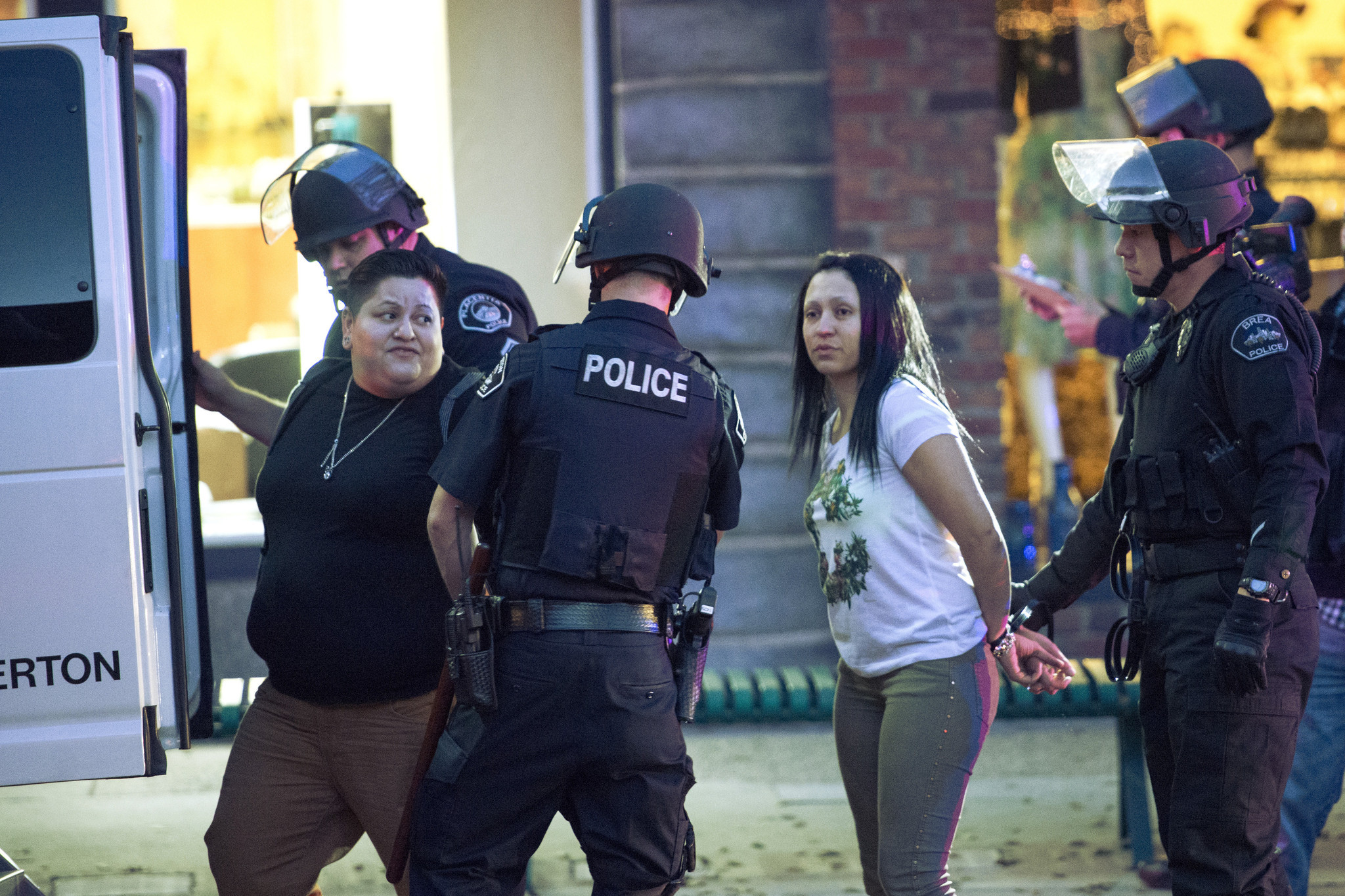
Protesters being loaded into a van on January 18. Image used without permission: (AP Photo/The Orange County Register, Kyusung Gong)
The Mid-June, 2014 Edition of the Fullerton Observer* devotes nearly all of it’s second page of print (available online as a pdf) to asking the Fullerton Police Department about both the arrests of protesters on January 18, 2014, and the subsequent arrest of A.J. Redkey in Pasadena months later. First, the Observer presents a timeline of the January protest against the “not guilty” verdicts in the trial of former officers Jay Cicinelli and Manual Ramos in the beating death of Kelly Thomas. The source of the timeline is noted as “Fullerton Police Dept. records.” FPD Public Information Officer Sgt. Jeff Stuart’s comments are inserted in italics, adding further commentary to the FPD’s own version of the events. Lamentably, there is no attempt to balance the FPD’s version of what transpired by interviewing participants in the protest.
The second story on the page takes the form of a “Q & A” wherein Sgt. Stuart responds to reader questions about police actions during and after January 18 and the arrests that followed. Readers will recall that A.J. Redkey was arrested months later in Pasadena by six officers for a non-violent misdemeanor, prompting questions about perceived retialiation against “citizen journalists” and the FPD’s use of resources to arrest a single man on such a minor charge so far away from Fullerton.
Sgt. Stuart takes several paragraphs to explain that a judge issued a warrant after the D.A. believed a crime had occurred, and that officers learned that Mr. Redkey would be in Pasadena on a specific date (probably by looking at Facebook?). Six officers were sent in a demonstration of overwhelming force in order to avoid a violent confrontation, although there is nothing in Sgt. Stuart’s explanation to suggest that Mr. Redkey had ever committed any act of violence against anyone, and, indeed, video of Mr. Redkey’s eventual arrest in Pasadena shows him surrending peacefully.
One has to wonder whether or not a little more research might have led the officers to Mr. Redkey closer to home, here in Fullerton, saving the taxpayers the cost of sending the six officers so far away to perform the task.
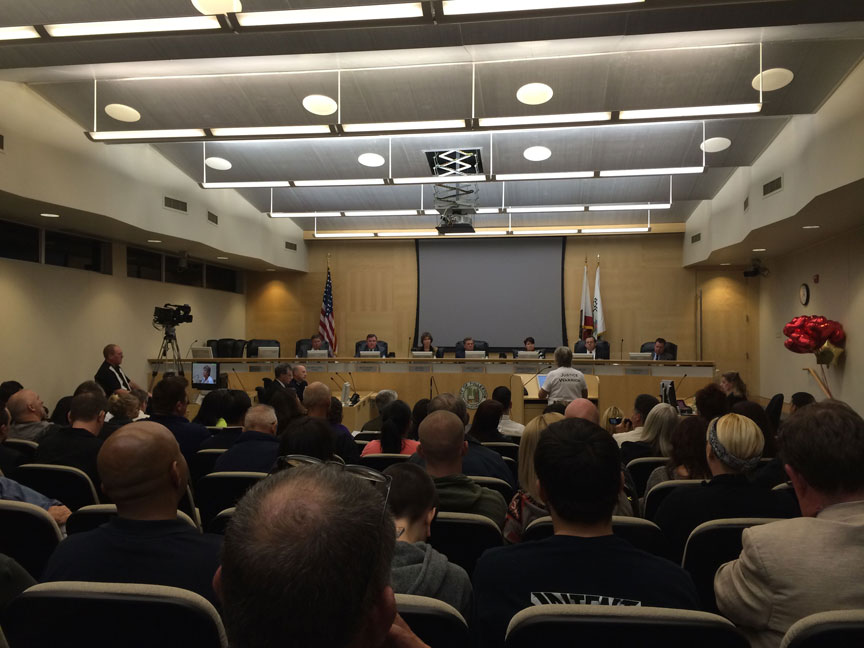
The final paragraph is devoted to avoiding a response to allegations that officers taunted and used threatening language to protesters after they were apprehended and loaded into a police van on January 18. At least two complained publicly to the Fullerton City Council on June 3 that one officer exclaimed “Not Guilty” to them, in presumed reference to the verdict handed down in the trial, and, more disturbingly, another told them to expect OC Sherrif’s deputies to beat their faces when they arrived in Santa Ana. Incredibly, Fullerton Police Chief Dan Hughes made no comment about the allegations at the June 3 meeting where he was present to deliver a report on the Redkey arrest and the January protest, even though all FPD officers wear Digital Audio Recorders, and the alleged comments would have been captured and archived for review.
One could only conclude that either Chief Hughes did not know about the allegations or that he was not prepared to comment on them. At the very least, however, one would have expected him to have promised to look into the matter. No such assurances were offered.
And now, nearly two weeks later, given yet another chance to let the public know whether or not officers of the Fullerton Police Deparment told arrestees that they were being taken to Santa Ana to have their faces beaten in, Sgt. Stuart completely avoids the question:
“With regards to allegations that officers made inappropriate statements to arrestees, each of our officers wears a digital audio recorder that captures all citizen contacts. Our policy dictates that those recorders remain activated throughout the contact, including the arrest and booking process. That information is discoverable for evidentiary purposes, by defense counsel for any of the arrestees. All files are digitally marked when the recorder starts and that information is downloaded into the database. Any attempt to alter, edit or otherwise change a file would be evidenced in the file.”
Why doesn’t Sgt. Stuart simply answer the question? Did Fullerton Police Department officers say what they are alleged to have said to arrested protesters, or didn’t they? The fact that the recordings are “discoverable for evidentiary purposes, by defense counsel for any of the arrestees” is not material to the question. The alleged comments and threats were said to have been made after the protesters had been arrested. While the defendents may wish to present the recordings as evidence that they were unjustly targeted for arrest, the public has a right, in the meantime, to know whether or not our police are threatening arrestees with violence.
Without a Civilian Police Commission the public has no way of knowing whether or not an investigation has even taken place, let alone what was “discovered” by it, or if any disciplinary actions were taken toward the officers allegedly involved, if anything was said in the first place. The Observer’s report relies entirely on the police themselves to provide an account of their own actions, and the Office of Independent Review hasn’t been heard from by the public since they were awarded a contract for an inadequate series of oversight functions last year. The only other limited oversight mechanism in place is the City Council itself, who are dominated by a majority of police cheerleaders in the form of Mayor Doug Chaffee and Council members Jan Flory and Jennifer Fitzgerald, who demonstated on June 3 that they had little interest at all in what a bunch of unruly protesters had to say about anything.
*On page 18 of the same edition the Observer unexpectedly reprints a June 9 Fullerton Rag blog post entitled The Latest Case for a Civilian Police Commission in Fullerton.


 fullertonrag.com