Archives for posts with tag: Downtown Fullerton

No Map 8

Map # 8, “truly bad.”

The following is a guest editorial by political science professor Vince Buck, a longtime commentator on Fullerton’s government.

Councilmembers:  What follows is not a letter per se, but part of an article I wrote after the last Council meeting. Due to deadlines it probably will not be published, but I am forwarding it to you because it summarizes my views on the current maps under consideration. I will be out of town and unable to respond to this message or attend the June 7 meeting.

Vince Buck

The Council  was  scheduled to decide on a map at the May 17 meeting, but at the last minute downtown business owners, who  had not previously participated in any significant way, showed up with  Map 8. Their stated goal is to see that every district has a piece of downtown. Rather than maintain a cohesive downtown neighborhood, it carves up the center of the city. Their map is truly bad. One district  runs the full width of the city, sometimes only a couple of blocks wide. Two other districts have long artificial extensions, needed in order to reach Harbor. Elbridge Gerry would have been proud.*

While the stated purpose is that all Councilmember will have a stake in downtown, the unstated  one is that business owners will have more influence with the Council. Why should downtown  interests be more favored than the businesses of the Orangethorpe corridor; or than Cal State or St Judes; or the many residential areas of the city?

But maybe  that is not the point. Perhaps the business owners want to divide up the downtown so that there is no one strong voice to represent the citizens of downtown who might complain  about all of the problems that the bars and restaurants create.

Whatever the case may be, the map and makes no sense other than to fracture downtown and in doing so it distorts the other communities  of Fullerton. And the political thinking behind it seems ill-founded. If every Council district touches upon the downtown area, then downtown counts for only a small percent of the voters in each district, which can then be easily ignored.

Moreover the political strength  of the business owners is  not based on votes, but on money (and perhaps standing in the community). The business owners themselves are not a significant voting bloc: most do not live downtown and many do not even live  in the city. If they need support from the Council  they can try to gain that support through campaign contributions, just as they do now.

For better and for worse, downtown is important to everyone in Fullerton. It is the core that helps make this a community and not just a group of homes. But  is also the source of many of our problems and our greatest expenses.   If it is important to every person then it is likewise important to all Councilmembers whether it is physically in their  district or not. Artificially carving up the downtown will not accomplish what the absentee business owners expect.

In contrast to Map 8, Map  2b, with all its shortcomings, is a reasonable choice (as is Map 10). It has the blessing of the consultant and meets the legal requirements. With little guidance from the Council or community,  David Ely has followed  a fair and objective process to  get to this point. Map 2B  is not a partisan nor economically motivated product. Its weakness is in District 3 which runs from east of the 57 Freeway to Euclid in a narrow swath across the center of Fullerton. It seems to be what is left over after the other four districts were drawn. There is no natural community here. Otherwise this map  respects neighborhoods (as does Map 10)  and it could be easily tweaked to  place the neighborhoods around Hillcrest Park and the south facing hills — all of which are part of the older Fullerton core community — into District 3 ; and then keep the areas east of the 57 Freeway in a single district (#2). If the Council is committed to 5 districts, Map 2b  should be tweaked, but ultimately supported.

Dr. Vince Buck is Professor Emeritus, Cal State Fullerton. He is a frequent contributor to the Fullerton Observer, and a former member of Fullerton’s Library Board of Trustees, General Plan Advisory Committee, and Bicycle Users Subcommittee.

*Elbridge Gerry, July 6, 1744 – November 23, 1814. Fifth Vice President of the United States, known as the namesake of gerrymandering, the much maligned process by which voting districts are devised, often with irregularly drawn boundaries, to produce premeditated political results meant to benefit one political party over another. (Note added by Fullerton Rag Admin)
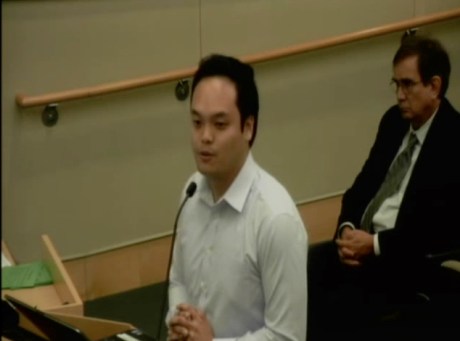
Sam Han

Grace Ministries Pastor and Republican State Senator District Director Sam Han, going to bat for the map the bar owners want.

Matthew Leslie
“My name is Sam Han, I’m a resident of the City of Fullerton. I’m also here representing Grace Ministries…,” said Samuel “Sam” Han to the Fullerton City Council on the evening of May 17, speaking during a public hearing about which district elections map to send to voters in November. After noting his service as a former Planning Commissioner, he offered a series of observations about the Korean-American community in Fullerton before stating “we don’t believe that the downtown area should just be monopolized by one member.” He continued, eventually offering support for the efforts of Downtown Fullerton’s bar owners to have all five proposed voting districts converge at the intersections of Harbor Blvd. and Chapman or Harbor and Commonwealth. This opinion, supporting the bar owners’ Map # 8, was offered “on behalf of the five thousand members of our church,” a sizable, primarily Korean-American church located on Commonwealth and Brookhurst, where Mr. Han serves as an Associate Pastor.

GMI Exterior

Grace Ministries…why do it’s 5,000 members care about what Fullerton’s bar owners want?

I’ve transcribed some of Mr. Han’s comments below so readers can try to follow the slender, meandering thread of reasoning he followed to reach his conclusion that a megachurch should take a position on a city’s district elections map, and, in particular, make a specific recommendation to have the district that would contain their church rub up against alcohol-saturated Downtown Fullerton.*

‘…over the years as we’ve worked together with the city council we’ve come to find that you have been receptive, at least to our voice, and some of the needs we have in our community. I will say that the district, unfortunately, creates a situation where you have one city council member who may be more interested in the voices of their particular constituency as opposed to the rest of the city. Koreans don’t just live in one district, we live in multiple districts throughout the city, and we would hope that rest of the members of the city council, even if we’re not a majority in your district, that you would still be attentive to our voices as well. With that being said, as a former planning commissioner myself, I’ve worked though many decisions on the dias, working with business owners downtown…”

And finally…

“I feel the map 8 would actually do a better job at representing a lot of our voices because the downtown area should be considered by all the members.”

We heard the same counterintuitive approach voiced by council candidate Larry Bennett, who replaced Mr. Han in 2014 on Fullerton’s Planning Commission as Mayor Jennifer Fitzgerald’s appointee. It didn’t sound any more convincing coming from Mr. Bennett, which is perhaps why Mr. Han took such a long and circuitous path to try to sound persuasive. He didn’t.

Slidebar-Alley

Outside the Slidebar: What Would Jesus Drink?

Readers will rightly wonder why two successive Planning Commissioners, both appointed by Ms. Fitzgerald, would rush to support a badly drawn map offered by, of all people, Jeremy Popoff, drummer for the band Lit, and owner of Downtown Fullerton’s Slidebar. The Slidebar is a popular place, but I’m guessing that on any given night it is probably not much populated by very many of the “five thousand” members of the Grace Ministries congregation.

To answer the question of why a megachurch whose congregants certainly don’t all live in Fullerton would send a representative to speak on behalf of a bar owners’ proposed map of the city’s possible election districts, we might refer to Mr. Han’s other gig as District Representative for 68th District Sate Senator Donald P. Wagner, a Republican.

Sam Han Collage.jpg

Sam Han didn’t mention his day job…

As noted in our post about Larry Bennett’s support for this ridiculous map, three of Map # 8’s five districts have Republican majorities, leaving only two districts with Democratic Party registrant majorities. Perhaps it just sounded better to have bar owners argue that everyone should “touch” a piece of the action downtown and have a pastor from a megachurch agree with them than it did to have two Republicans appointed by Jennifer Fitzgerald argue for a map that would likely preserve that party’s majority on the Fullerton City Council.

*(Maps #2B  and Map # 11 both group GMI with a west-side district that doesn’t reach downtown; Map #10 includes GMI with all of the downtown).

Ramirez Letter

Matthew Leslie

On May 23 the website Voice of OC published an editorial by Richard M. Ramirez, Ed.D. Dean, Emeritus, Fullerton College, wherein he took exception to the Fullerton City Council’s May 17 vote to continue the decision over which District Elections Map to adopt for a November ballot initiative to June 7, rather than make the choice that night. He also advocated for Map 2B, one of the four maps to be considered by the council on June 7, at their regular meeting. The editorial was also published as a letter to the editor in the Early June edition of the Fullerton Observer.

Because the Fullerton City Council’s next meeting on June 7 will occur prior to the next scheduled print edition of the Fullerton Observer, I am reprinting my response to the letter/editorial by Dr. Ramirez below, preceded by his text for context. My comments can also be found on the Voice of OC site, just under the editorial by Dr. Ramirez.

Ramirez: Fullerton City Council vs. Public Trust

By Richard M. Ramirez, Ed.D

May 23, 2016

I was invited by a friend to attend the May 17th Fullerton City Council meeting, as the Council was scheduled to take action on the issue of voting districts and the selection of a map to be placed on the November 2016 ballot.  As an observer of the meeting, I was impressed by the high number of attendees.  It was evident that the cited issue had drawn a significant number of community folks after Mayor Fitzgerald had asked how many were interested in making public comments; over twenty-five attendees raised their hands.

Based on the public comments, out of various proposed maps, two were advocated by the presenters for Council approval; Map 2B and Map # 8.  Quite candidly, the majority of the presenters were very well prepared and articulated their position with sound rationale.

However, a key difference is that one of the maps was community driven and advocates for Map 2B had exercised a seven-month long inclusive process.    On the other hand, based on folks who advocated for Map # 8, it was very clear that this map was business driven. Additionally, the construction of this map can be viewed as exclusive in nature based on the fact that it was recently written and not part of the directed public process.

It is important to note the importance of the public process given the magnitude and the historical significance of the Voting Rights Act of 2001, which is the driving force for the establishment of voting districts.  One of the presenters, Mr. Jonathan Paik, gave an excellent presentation regarding the seven-month long public process.  His detailed comments made it very clear that the process was very inclusive and all had been done to be compliant.  In the final analysis, those who participated in this public process supported Map 2B and encouraged the Council to take appropriate action and approve Map 2B.  The folks who advocated for Map # 8 made it very clear that the construction of this map was basically an “11th hour” product.  Given this clarification, one can surmise that the business owners did not subscribe nor practice a public process.  Hence, the exclusive process prevented the public at large to study and review the merits of the proposed map.

One further observation is that this issue was on the May 17, 2016 agenda, “Public Elections Mapping Process – Voting Districts Formations,” as an action item.  The language read, “Final public hearing to review community input on the City Council voting district elections mapping process, discussion of proposed district maps and selection of map to place before the voters in November election.

Recommendations by the City Clerk’s Office:

1 Receive presentation and recommendations regarding voting district maps.

2 Hold fourth and final public hearing to receive public input on district map.

3 Discuss voting district formation and close public hearing.

4 Per terms of the Settlement Agreement, select map to include on the November

2016 ballot measure asking voters to decide whether to approve voting district elections as defined by the selected map.”

Based on the language applied in the agenda item above, it is very clear that the majority of those in attendance expected the Council to take action.  Unfortunately, the Council’s decision not to take action has seriously jeopardized a most critical relationship with the community they had taken an oath to serve; public trust.  Council members may eloquently rationalized their decision not to take action.  However, even the Nicholas Jr. High students, who were in attendance at the initial part of the meeting to present their social enterprise business projects, would have been shocked by the Council’s inaction.  Fortunately, they left the meeting after their respective presentation and did not witness a travesty and breach of public trust.

My assessment of the cited observations is that the premise for the Voting Rights Act of 2001 was well demonstrated by what did not happen.  One can only assume that the Council’s inaction was prompted by the need to be “fair’ to the downtown business owners.  However, it was very evident that those who did everything right, followed the public process and were inclusive in all aspects, were treated unfairly.  May 17, 2016 will be viewed by many Fullerton community residents as a “Day of Shame.”

Richard M. Ramirez, Ed.D. Dean, Emeritus, Fullerton College

Response by the Fullerton Rag, posted May 23 to the Voice of OC website:

Dean Ramirez,

Thank you for attending the May 17th meeting of the Fullerton City Council. Your comments above represent a generalization of the proceedings, and would benefit from the inclusion of other salient facts:

Although it is true that most attendees who spoke that night either supported map 2B or 8, map 10 also had supporters, and for this reason was included in the final four maps to be considered by the council on June 7.

Map 8 is a disaster, and, as you note, was driven by late-to-the-game businesses trying to look out for their own comparatively narrow interests, but Map 2B has its own problems. Map 8 fragments the downtown residents by splitting up their voices, but Map 2B absurdly lumps most of them with Cal State Fullerton. Not a single supporter of 2B that night acknowledged this poor mapping to be a problem, let alone offered a remedy to it. They too, have their own interests in mind, to the exclusion of the interests of others.

Map 2B itself is a revision of an earlier map offered at one of the public meetings. This revision resulted from a PRIVATE meeting with the city’s hired demographer, David Ely–a meeting to which not all participants in the many public meetings were invited. I believe not all of the people who worked on 2B even live in Fullerton.

Paid political organizers from the Orange County Congregation Community Organization (OCCCO) are working on behalf of 2B. When I met with one, and pointed out how one district in 2B stretched nearly all the way across the city for a forced marriage of CSUF and Downtown Fullerton, he had nothing to say other than that no map was perfect (twice!).

The item was originally scheduled to be heard on June 7. It was the OCCCO organizers themselves who asked for an earlier date because they were concerned about the item conflicting with election day (perhaps OCCCO organizers will have other professional duties that night ?). There was an option to move it to a later date than June 7, but the OCCCO organizer involved chose the earlier date of May 17. Tough luck. It was a gamble for him that didn’t pay off.

It was not a bad idea to refrain from making a decision on May 17. It should have been obvious to anyone watching that the some City Council members were not adequately familiar with the maps or the process to make a responsible decision that night. Instead, they asked that the four maps that had received support from the public that night (2B, 8, 10, and 11) be considered on June 7, and set May 24 as a final date for revisions to these maps that might ameliorate concerns with problems expressed about each one. Has there been a revision offered by the authors of 2B to address the concerns about it expressed above?

Fortunately, there is a free Public Forum scheduled to discuss each of these maps on June 1, 7:00 p.m., at the Community Room of the Fullerton Public Library, 353 W. Commonwealth Ave. The authors of all four maps have been invited. I hope all of them, and you, will choose attend.

Fullerton Rag