Archives for category: Greg Sebourn

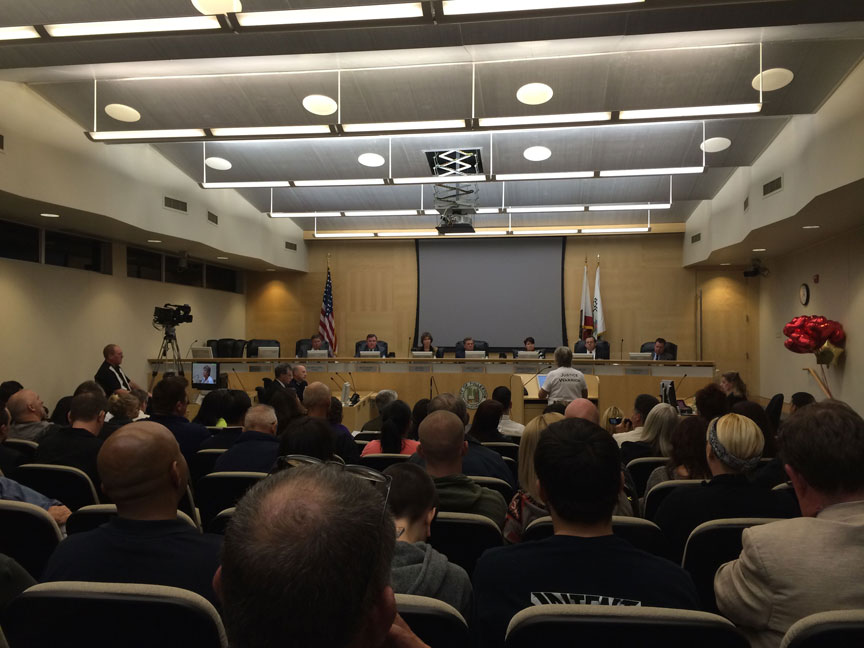
On the evening of June 3 the Fullerton City Council heard a report from Police Chief Dan Hughes about the arrest of live-streaming “citizen journalist” A.J. Redkey the previous month. Council member Bruce Whitaker, seconded by Mayor Pro Tem Greg Sebourn, had asked for the item to appear on the agenda in response to public questions about the expense and purpose of sending six officers to Pasadena to arrest Mr. Redkey for a non-violent misdemeanor in May. The Chief reported that the actions of his officers were in line with other arrests. He also insisted that the department did not target for arrest those who video record their actions, saying “We could care less if they’re live-streaming.”

The scheduled report afforded the Chief a chance to quote statistics about arrests, and to offer a narrative meant to establish the rationale for the department’s forceful response to the January 18 protest, but left unanswered questions.

Never did the Chief address repeated and virtually identical allegations made by two other “citizen journalists” that his officers had uttered threats and gloating remarks to arrestees locked up in a police vehicle following the January 18 protest in front of the department headquarters. Both claimed that an officer opened a police vehicle door and said the words “Not Guilty” to them and others arrested for allegedly failing to disperse from the protest. The officer’s words would have been a reference to the jury decision not to convict former Fullerton officers Manual Ramos and Jay Cincinelli in the death of transient Kelly Thomas that prompted the protest. Even more disturbing was the claim that another officer later told those arrested that they would be sent to Santa Ana, where twelve OC Sheriff deputies were waiting to “beat their fucking faces in.” Chief Dan Hughes ought to be prepared to offer a report about these allegations of outrageous behavior by his officers at the soonest possible opportunity.

In the end, we were left with platitudes of support for the FPD by the reliably compliant council majority of Mayor Doug Chaffee and Council members Jan Flory and Jennifer Fitzgerald, and a dissatisfied crowd of audience members unconvinced by the Chief’s assurances that they themselves were not the targets of police harassment. This uncomfortable impasse needn’t persist. The establishment of a fully independent Fullerton Police Commission could offer substantive responses to unanswered questions and, at least partially, resolve the constant state of mistrust on the part of some community members and the FPD. A rightfully empowered commission could offer a more independent and comprehensive response to public complaints.

It will be instructive to learn what, if anything, the Office of Independent Review, who have been tasked with periodically assessing the Fullerton’s Police Department’s performance, has to say about the entire affair. In the meantime, a functioning civilian Police Commission could have been conducting its own investigation. How many raucous evenings of complaints against the FPD is the Fullerton City Council willing to endure before it will even consider establishing such a commission for the public’s peace of mind?

FrackingWastePit_BGS_WEB

Our drinking water could be at risk.

One vitally important issue left entirely out of Fullerton’s pending Legislative Platform, to be considered tonight, is support for state legislation imposing a statewide moratorium on hydraulic fracturing, or “fracking”, of oil and gas wells. Fracking has been linked to both groundwater contamination and earthquakes, and should be entirely banned as a method of fossil fuel extraction. The process, which involves injecting wells with unknown chemicals at high pressure to cause fissures, freeing deep deposits of gas and oil, also uses huge amounts of water our state can’t afford to waste.

There is already a nationwide grassroots movement to ban the practices of acidizing and fracking.

Ohio recently declared local moratoriums on fracking after its Dept. of Natural Resources declared that there was probably a link between the process and the occurance of earthquakes near drilling sites. Closer to home, the City Council of Carson, CA voted unanimously last month to place a temporary ban on all new oil and gas drilling amid worries that fracking might be used to drill there. The City of Los Angeles has already banned the practices of fracking and acidizing of wells.

North Orange County residents are already asking whether or not the recent La Habra earthquake and it’s seemingly endless aftershocks were caused by fracking in the oil fields near its epicenter. While it is true that earthquakes are hardly a rarity in Calfironia, and that oil tends to be found near faultlines, it is not unreasonable to declare a moritorium on fracking in the city until we can find out for sure whether or not there is a connection. Let’s also lend our support to a statewide moritorium.

The Fullerton City Council’s 2014 Legislative Agenda should include strong support for Senate Bill 1132, which would institute a moritorium on fracking. The bill was approved, albeit narrowly, by the Senate Natural Resources and Water Committee last week. Our state representatives, Assembly member Sharon Quirk-Silva and State Senator Bob Huff should be prepared to support this legislation, and our City Council should be there to back them up.

Chemical laden water is routinley pumped back into the ground to dispose of wastewater from fracking. Fullerton is lucky to have groundwater to supply much of our drinking water needs. Chemicals migrating from aging concrete lined wells, which ultimately fail over decades, could contaminate our drinking water, causing a catastrophe for the city. It is simply not worth the risk to allow drillers to extract the last deposits of fossil fuel from fields that have already been producing for the better part of a century.

Council-Chamber-Post-Verdict

The Fullerton City Council moved item twelve, an update from Chief Hughes about the trial of two former officers acquitted of charges in the death of Kelly Thomas, to the beginning of its meeting agenda tonight. Of the fifty or so members of the public who spoke about the item, nearly a dozen expressed support for civilian oversight of the Fullerton Police Department. Following public comments of the issue, Councilman Bruce Whitaker reminded the audience that he did support a public police commission, and voted against the proposal to hire the Office of Independent Review to provide a lesser model of oversight through outside audits by Michael Gennaco’s OIR.

Councilwoman Jan Flory claimed that the subject was dealt with on two different occasions, and even cited a study session held at the new community center as an example of the council’s consideration of different models of oversight. Readers will recall that the Police Oversight Proposal Committee (POPC) was limited to less than ten minutes to present a model of public oversight following lengthy presentations by the chief of police and Michael Gennaco. Almost no discussion of the proposal took place at that time. There has never been a real public discussion of police oversight by the Fullerton City Council.

Readers will also recall that Ms. Flory was supported by the Fullerton Police Officers Association in the 2012 elections. The FPOA spent tens of thousands of dollars to ensure that they elected a candidate who would privilege their priorities over the interests of the public.

Ms. Flory claimed that the POPC proposal was in conflict with state legislation that protects police officers, and that the council was advised by lawyers that they should not adopt a civilian police commission.

Of course, The Peace Officers Bill of Rights does severely limit the public’s access to information about police misconduct, making real oversight somewhat complicated. But such civilian oversight is certainly not impossible, and is vital to a community where people can be beaten in the streets by the police and be found guilty of nothing by a jury.

Councilwoman Flory ought to take the public’s demands for civilian oversight more seriously. If she thinks state law is standing In the way of it, we will expect her leadership in efforts to change that law. We request that she contact our state legislators on behalf of the people of Fullerton to reform POBR.

Police-Council-Door